Back from Thailand: reflections on the need for transformational change

I’m back from Thailand and currently dealing with a chest infection. Travelling takes it toll, both on my health and on that of the planet. I live with these inconsistencies. From my arrival late on 19 October through to the morning of 23 October I was based in Bangkok, staying in one of my favourite hotels. By very good fortune it was 10 minutes walk from the United Nations Conference Centre, where the Asia Pacific Climate Change Adaptation Forum was held.

The forum was an interesting experience, particularly in terms of feedback from my Agri-Nature Foundation friends who were also in attendance. I’ll come to this in a while. The theme of this forum was ‘mainstreaming’ adaptation to climate change. The mainstreaming of adaptation into national policy frameworks, particularly in least developed countries, has gained significant momentum in the last few years. This momentum is a result of the significant, and increasing, amounts of funding for adaptation that are coming available. It is recognition that climate change is happening and there will be inevitable negative impacts on environments and people around the world. I see this increased attention to adaptation as a mixed blessing. On the one hand it reflects the need for positive action to address the effects of climate change, which if done properly could also provide benefits in terms of reduced emissions. But the speed at which things are happening, and the lack of genuine expertise, is a big concern. Funds are coming available almost faster than various agencies can keep up with. And suddenly there are a whole lot of ‘climate change experts’. The one big contradiction that I see is that a lot of people are talking about the need for action, and agreeing that they need to have more meetings to talk about action, but where is the action and who is doing it? And exactly what sort of action are we talking about? Are we talking about incremental changes to what we are currently doing? Or are we talking about transformational changes?
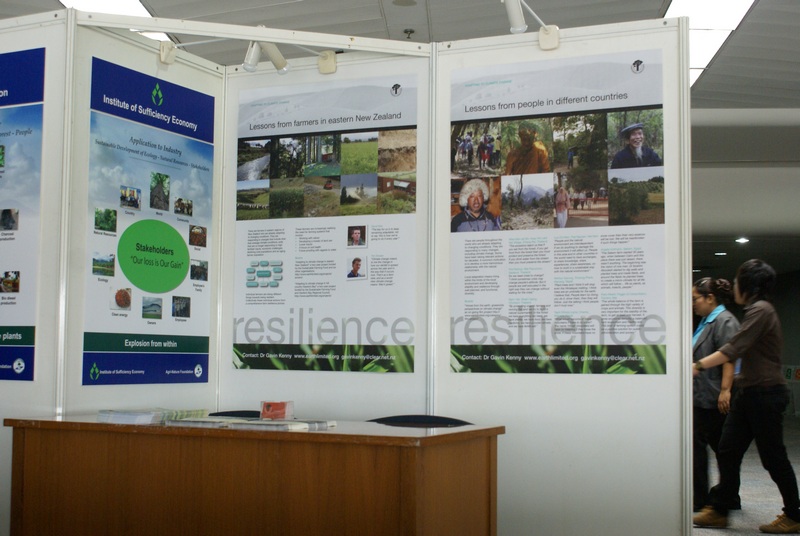
My posters on display in Bangkok - lessons from practical people who are involved in transformational change

I view incremental changes as adjustments we make to partially offset the negative consequences, and potential vulnerabilities, of our on-going economic development focus. In many countries, including New Zealand, this includes continuing with activities such as high input agricultural systems (particularly our dairy industry) but doing things like improving irrigation efficiency or dealing with the consequences of nitrate pollution. We’re not questioning the future vulnerability and costs of sustaining such systems. Evidence from past civilizations gives us some clear lessons. In the words of Brian Fagan, author of ‘The Long Summer: How Climate Changed Civilization’ (It’s also worth reading this Guardian review):

“In our efforts to cushion ourselves against smaller, more frequent climate stresses, we have consistently made ourselves more vulnerable to rarer but larger catastrophes. The whole course of civilization … may be seen as a process of trading up on the scale of vulnerability.”

Whether we see it or not, our present actions are accelerating us towards a collision course. The economic rationalists tell us that we have no alternatives. I guess this makes sense if you understand the causes of tunnel vision. I liken our addiction to fossil fuels and the growth economy to the effects of alcohol and some drugs on vision. We’re in a world of rapid change and we humans are increasingly in need of transformational change. My view is that we either act willingly now, or be forced into change at much greater cost sometime in the future.

Transformational change means we step outside of the square. We shed our strong dependence on fossil fuels and start opening our minds to the world of possibilities that lies beyond what can only be described as addictive, and ultimately destructive, behaviour. The sooner we make this change the better. Yes, it might involve some short-term pain, changes in lifestyle and consumer behaviour. Long-term, the sooner we act the better placed we will be to benefit from a genuinely harmonious and productive relationship with the earth.

It’s taken me a while, but this is where I come to the Agri-Nature Foundation in Thailand. Through the practical application of the Sufficiency Economy philosophy they are actively engaged in transformational change. My friends, Ajarn Yak and Khun Wipa, were very frustrated with the adaptation forum. All of this talk about the need for action, and they are acting. Mainstreaming adaptation is a redundant concept for them. Their work isn’t driven by a climate change funding agenda. It was originally driven by a challenge from farmers to show that the King of Thailand’s ideas on the Sufficiency Economy had some practical merit. Their funding has come from people freely offering financial support because of the results they are getting. The Sufficiency Economy is a response to the forces of globalisation and the many environmental and other problems now unfolding in the world. This includes climate change. Practical application of the Sufficiency Economy involves planting a diversity of tree species, protecting precious water resources, living within the limits of your local environment, providing for your basic needs and sharing surplus. It follows fundamental ecological concepts. The foundation is a sustainable and resilient ecology. Through a conscious design process we develop greater stability, and buffering capacity, through well-planned functional diversity. Within this we develop a healthy social environment and then a sustainable economy. I know various people talking about these concepts. I know very few examples of practical application. In this regard the work of the Agri-Nature Foundation needs wider recognition and I’m dedicated to supporting that as well as I can.

Back to Thailand

Earlier this year I had a phone call out of the blue from a friend in Thailand, Khun Wipa. I hadn’t spoken to her since 2007 when we were travelling and filming grassroots perspectives on climate change. She was phoning me on behalf of Ajarn Yak who wanted me to come back to Thailand to contribute to a grassroots gathering of the Agri-Nature Foundation. I was subsequently in Thailand for just over a week, from 16 to 24 March. I haven’t yet written about this trip, but it’s on my list of things to do!

The point of this is that I am heading back to Thailand next week. My initial motivation for returning was to attend the Asia-Pacific Climate Change Adaptation Forum. I will be showcasing some of the work that I’ve done over the last decade as well as helping profile the work of the Agri-Nature Foundation. I’ve already given them some assistance in the translation of some of their information. Here are the two posters that I will be putting on display:

Poster 1: Lessons from farmers in eastern New Zealand (2.33 MB)

Poster 2: Lessons from people in different countries (2.04 MB)

I’ve also been invited to act as provocateur for a session on climate uncertainty. In preparing for this last week I recalled that uncertainty was the topic of my first ever talk on climate change in 1991. I’ve certainly learnt a few things since then.

Following the adaptation forum I will again be hosted by my friends at the Agri-Nature Foundation. We’ll most likely be going to the Agri-Nature centre at Maab Uaeng in Chonburi province.

Film project

A short clip from the villages of Chame and Manang in the Annapurna region of Nepal. Included is a brief interview with a local conservation officer.

This clip is a sample from the 34+ hours of film that I recorded in 2007 as part of an on-going film project. I’ve presently got a rough edited 25 minute segment of film but progress has been slow. Lack of funding has been the main impediment to completing this, so if you can help me in any way please let me know.

The importance of working together

Climate change is real and we humans have contributed significantly to this. I have no doubt in my mind now. The scientific evidence is there. More importantly people on the ground are experiencing profound changes. Hearing this from local people is one of the most important things that I gained from travelling through Asia to Europe with my family in the first half of this year. If you haven’t read our blog from this journey check in the archives.

Another important thing that I gained was a deepened sense of hope amidst the very clear evidence of overpopulation, pollution and environmental degradation in many countries. There are people, a minority still, who are acting for the future now. I’ve talked about this as I shared stories from our journey.

What I also gained was a deepened understanding of the long-term connection to nature that exists in many countries, both eastern and western. This connection is not always obvious, but it is evident in some landscapes and in the things that some people are now doing. There is a renewal, a reawakening, a rethinking of things that is beginning to emerge. My experience of this was cause for reflection on New Zealand where we are still working out how to live together and with our unique, but hugely modified, environment.

With only 4 million people and an abundance of natural resources, surely we can get it right? If we can’t, who can? What we need to do, and this is a very big challenge for New Zealanders, is to embrace our past, look beyond our differences and start working together for our collective future much more than we are. I hear it said that we can’t look forward until we have effectively dealt with the past or resolved our differences. Will we ever? There is a different way. By working positively together for our shared future we will also find ways to address the many social, economic and environmental issues that we have. In my view it is a matter of urgency that we do this. Change is happening in the world to a much greater degree and at a much faster rate than we fully appreciate here in New Zealand. I’m not a doomsday person but I do believe that we are either going to choose or be compelled to work together much more than we presently are. If we do this by choice and with vision then we have real potential to provide leadership for the world.

A letter of thanks

Dear Everyone!!

Late last year my family and I made a decision … my older sister and I had sold our Mum’s small house in New Zealand. We had a choice, either pay off the mortgage on our own home or travel and document grassroots perspectives on climate change. Of course you all know what we chose to do.

It took a huge effort to organise our journey, but we could never have done it without all of you. In various ways you all helped us along the way. I want to especially mention Khun Tuenjai and her amazing network of people in Thailand. You organised such a busy itinerary for us to start our journey, but it was such a rich experience and we met so many warm, generous people in your country… too many to name here. After Thailand we were on our own a lot more and it was very hard work at times to meet and film people and places. But we managed. Viet Nam was hard, but we have some very good friends there who did their very best to help us. Our brief stay in India was greatly helped by Andy in New Delhi.

Nepal was both challenging and inspiring … for Lena, Ali and I it was truly a highlight of the journey to walk together for 19 days and to cross Thorong La Pass (5400 metres). Amidst illness and long days walking we managed to capture a few gems on film. I greatly enjoyed meeting Ngamindra and his colleagues in Kathmandu and I sincerely hope we can find a way to work with and support you. Everything in Egypt came together at the last minute, but again we met such warm, hospitable people who did their best to help us. Thankyou to Angela and Selim, and to Prof Zakharia for compelling me to go out to the Western Desert where we again met some wonderful people at Bahariya Oasis … thankyou Ahmed and Corien.

In Italy I have to thank Marco and his small team and I sincerely hope we can keep working together and find ways to work with all of these other wonderful people we have met. And who would have imagined the connection with Katharina and Alfredo in a beautiful valley in Umbria … a place we went to because the accommodation was a good deal and it looked nice! In Milan, thankyou to Iva and Paolo for having us in your home. We experienced the same warmth again with the Galli family in Lugano. Our time in France was too short, but thanks to Remy for having a bit of time to meet and talk… and to Jean-Pierre and Claire in the south of France for your wonderful work. Unfortunately I’m not able to communicate to many of the real grassroots people we met … farmers, village leaders and others … Thankyou to those of you who helped me meet all of these people.

A special mention goes to my cousin, Michael, who has done such a wonderful job with the blog page. And to my big sister Jill for buying me such a great hat!…. and to everyone else who I haven’t mentioned by name!!

We’ve come to the end of our journey now. On Saturday, 7 July we leave London for New Zealand. Lena is staying on here until late October and has already started a job here in London. For me the last week or so has been a time to rest and reflect. I have a lot to do when I get home, not least of which is to start earning some money again!! I still don’t know yet how I’m going to produce a documentary out of all that we’ve done. But it will happen somehow.